

Blog
Where Should You Position Your BBQ in an Outdoor Kitchen?
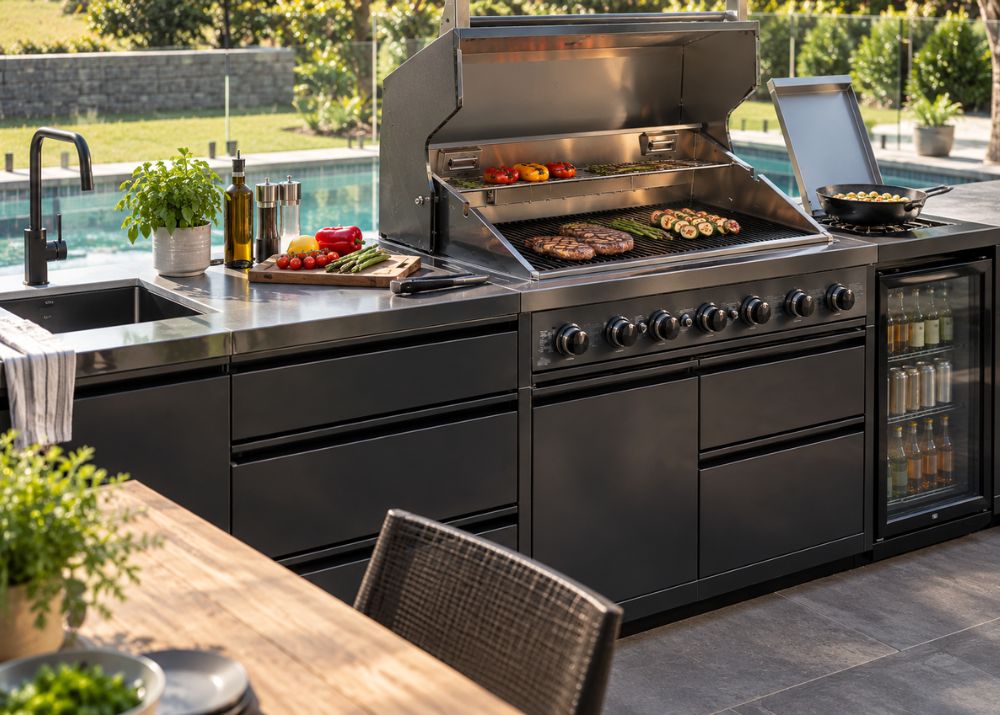
When designing an outdoor kitchen, one of the most important decisions is where to position the BBQ. It may be the centrepiece of the space, but choosing its location based on looks alone can lead to problems once you actually start cooking and entertaining.
Good outdoor kitchen BBQ placement should take into account how you cook, where people gather, ventilation, access to bench space and the other appliances you plan to include.
Getting the positioning right from the beginning can make your outdoor kitchen safer, easier to use and much more enjoyable.
Make the BBQ Part of Your Cooking Zone
Think about your outdoor kitchen as a working kitchen rather than simply a row of appliances.
Your BBQ should ideally be positioned where you can easily move between food preparation, cooking and serving. Having usable bench space close to the BBQ gives you somewhere to put ingredients, trays, utensils and cooked food without constantly moving around the outdoor kitchen.
If possible, allow for preparation space beside the BBQ rather than positioning it tightly between other appliances or cabinets.
Consider Where the Smoke and Heat Will Go
Before deciding on your built-in BBQ positioning, consider what is above and around the cooking area.
BBQs naturally generate heat, smoke, grease and cooking fumes. In a completely open outdoor area these can dissipate relatively easily, but an alfresco area with a roof, walls, blinds or other enclosures may require more careful planning.
You don't want smoke constantly drifting towards your outdoor dining table, entertaining area or back into the house.
Depending on the BBQ, outdoor kitchen design and degree of enclosure, appropriate ventilation or a suitable outdoor rangehood may also need to be considered.
Don't Put the BBQ Too Close to Where Everyone Sits
It can be tempting to position the BBQ directly beside the main entertaining area, so the cook remains part of the action. However, you don't necessarily want guests sitting immediately beside a hot cooking surface.
Allowing some separation between the cooking and seating zones helps keep people away from heat, smoke and splattering grease while still allowing whoever is cooking to interact with family and guests.
This becomes particularly important when you're entertaining larger groups or have children moving through the area.
Think About Access from the House
Consider the route between your indoor kitchen and outdoor kitchen.
Even with a fully equipped outdoor kitchen, you'll probably still carry food, drinks, plates and ingredients between the house and outdoor area.
Ideally, your BBQ should be easy to access without creating a major thoroughfare directly through the cooking zone. You don't want people repeatedly walking behind or directly past the person using the BBQ to get outside.
A well-planned layout separates the main traffic path from the hottest and busiest part of the outdoor kitchen.
Look at Your Available Bench Space
One common mistake is trying to fit as many appliances as possible into the available outdoor kitchen.
A BBQ, fridge, sink, wok burner and other appliances may all sound useful, but don't sacrifice all your preparation space to fit them in.
Your BBQ will be much easier to use when you have sufficient bench space nearby.
Think about where you'll put:
- raw ingredients waiting to be cooked
- BBQ tools and utensils
- serving platters
- marinades and seasonings
- cooked food coming off the BBQ.
Having functional bench space beside your BBQ can be more valuable than squeezing another appliance into an already crowded layout.
Consider Your Other Outdoor Kitchen Appliances
The BBQ shouldn't be planned in isolation.
If you're incorporating a sink, outdoor fridge, wok burner, pizza oven or other appliances, think about how they'll work together.
For example, positioning the fridge within easy reach can be convenient, but it shouldn't interfere with your cooking space. Similarly, a sink can be useful for food preparation and cleaning, but the overall layout should allow you to move comfortably between each area.
The aim is to create a logical workflow rather than simply filling every available cabinet module.
Check the BBQ's Installation Requirements
Not every built-in BBQ can simply be installed wherever you want it.
Different models can have specific requirements relating to clearances, ventilation and the materials surrounding the BBQ. These requirements become particularly important when the BBQ is being installed into cabinetry or near combustible materials.
Always check the manufacturer's installation requirements for the specific BBQ you're considering before finalising your outdoor kitchen design.
This is one reason it's worth choosing your BBQ before the cabinetry and benchtop design is locked in.
Don't Forget Your Gas or Power Connections
Your BBQ's fuel source can also influence its position.
If you're using natural gas, LPG or an electric BBQ, the appropriate connections need to be incorporated into the outdoor kitchen design. Other appliances may also require electrical outlets, plumbing or drainage.
Planning these services early is generally much easier than trying to accommodate them after the outdoor kitchen has been built.
Should the BBQ Be in the Centre of the Outdoor Kitchen?
Not necessarily.
While placing a built-in BBQ in the centre can create an attractive symmetrical design, the best location depends on the overall space.
In some outdoor kitchens, positioning the BBQ towards one end creates a larger uninterrupted preparation and serving area. In others, a central BBQ with bench space on either side works extremely well.
Rather than automatically centring the BBQ, consider how you'll use the kitchen.
Plan the BBQ Before You Finalise Your Outdoor Kitchen
Your BBQ is likely to be one of the most frequently used parts of your outdoor kitchen, so its position deserves careful consideration.
Think about outdoor kitchen BBQ placement early in the planning process, including ventilation, bench space, traffic flow, nearby seating and the location of your other appliances.
Most importantly, choose your built-in BBQ and check its installation requirements before finalising cabinetry and benchtop dimensions. A little extra planning at this stage can make a significant difference to how practical your finished outdoor kitchen is.
Planning an Outdoor Kitchen?
BBQs R Us can help you choose the right built-in BBQ and outdoor kitchen configuration for the way you cook and entertain.
Explore our range of outdoor kitchens and built-in BBQs online or visit our Mitcham showroom to discuss your options and start planning your outdoor cooking space.